


For many physicians, maintaining professional credentials means keeping track of two important requirements: Continuing Medical Education (CME) and Maintenance of Certification (MOC). While the terms are often used interchangeably, there are clear differences. Understanding the distinction between CME and MOC can help physicians stay compliant, avoid unnecessary stress, and choose educational activities that maximize their time and effort.
What Is Continuing Medical Education (CME)?
Continuing Medical Education (CME) is exactly what it sounds like: educational activities designed to help physicians maintain, develop, and improve the knowledge and skills needed to provide quality patient care. CME is primarily tied to medical licensure requirements and is often required by state medical boards, hospitals, employers, and insurance providers. Physicians earn CME credits through activities approved by the American Medical Association (AMA) or the American Osteopathic Association (AOA).
Specific CME requirements will vary depending on the state where a physician practices. Some states require a certain number of CME credits annually, while others operate on multi-year renewal cycles. In addition, some states require credits for specific topics such as pain management, opioid prescribing, ethics, or patient safety. For example, take an Internal Medicine physician who practices in Delaware. To stay licensed in Delaware, the AMA requires you to complete 40 total CME hours every 2 years. 2 hours must be on controlled substance prescribing practices and 1 hour must be on prescribing and distribution of controlled substances.
Doctors who fail to meet these state CME requirements will lose their state board medical license. They can also be subject to face penalties and fines if they continue to practice without a valid license.
CME opportunities are available in a wide range of formats, including:
- Online Courses
- Question Banks
- Medical Conferences
- Journal-Based Learning
- Grand Rounds
- Quality Improvement Activities
- Point-of-Care Learning Tools
What Is Maintenance of Certification (MOC)?
Maintenance of Certification (MOC) is a continuing certification process administered by specialty boards. Unlike CME, which is generally tied to state licensure, MOC is tied to maintaining board certification in your specific specialty.
The exact requirements vary by specialty board, but MOC is designed to demonstrate that physicians continue to meet specialty-specific standards for knowledge, professionalism, and patient care throughout their careers. Many boards require physicians to earn MOC points, participate in ongoing learning activities, and complete some form of knowledge assessment or examination.
Let’s look at the Internal Medicine doctor who practices in Delaware. In addition to the CME requirement of 40 total CME hours every 2 years (for licensure renewal), the American Board of Internal Medicine (ABIM) requires this doctor to earn 100 total MOC points every 5 years to maintain board certification.
Physicians are still able to practice medicine if they fail to complete MOC requirements and lose board certification, as long as they complete CME requirements and maintain an active medical license. However, board certification often plays an important role in hospital credentialing, employment opportunities, payer participation, and professional credibility.
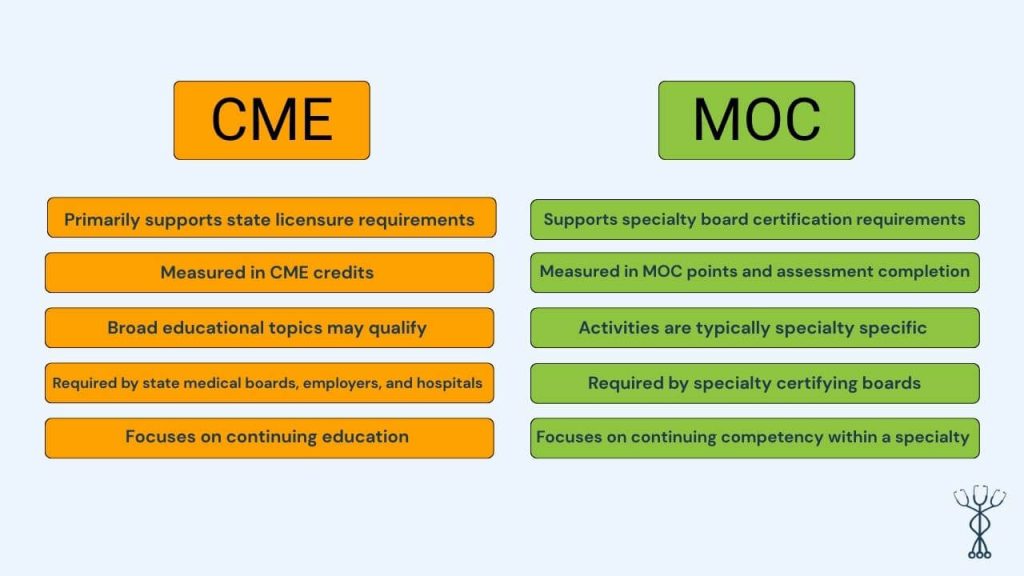
What are the Differences Between CME and MOC?
Both CME and MOC are designed to promote lifelong learning; however, they address very different professional requirements.
For example, for a doctor certified in Internal Medicine, Delaware requires 40 total CME hours per year to keep your license. But the ABIM requires 100 MOC points every 5 years to keep your certification.
A simple way to think about it is this: CME helps you maintain your license to practice medicine, while MOC helps you maintain your board certification within your specialty.
Can You Earn CME Credits and MOC Points at the Same Time?
In many cases, yes.
Over the past decade, specialty boards and accredited CME providers have expanded opportunities for physicians to do both: earn MOC points while participating in CME activities.
When physicians complete these activities, the provider can often report completion directly to the relevant board, allowing participants to earn both CME credits and MOC points for the same educational effort.
This dual-credit approach has become increasingly popular among busy physicians. For physicians balancing clinical responsibilities, administrative requirements, and limited time, choosing educational activities that satisfy both CME and MOC requirements can be one of the most efficient ways to maintain professional credentials.
BoardVitals offers CME and MOC opportunities across a wide range of medical specialties, making it easier for physicians to stay current, maintain certification, and satisfy licensure requirements from a single platform. BoardVitals provides accredited CME activities and specialty-specific learning experiences that allow many physicians to earn both CME credits and MOC points simultaneously.